The Elderly Woman Locked Her Doors When a Biker Pulled Up Beside Her Broken-Down Car on a Deserted Highway — “I Can Fix That Faster Than They Can Get Here,” He Said Through the Glass, But the Moment She Noticed the Small Crescent-Shaped Scar on His Hand and Whispered “That’s Not Where You Got That,” Everything About Him Changed and the Truth He Thought Was Lost Came Back All at Once
The kind of story that stays with you doesn’t always announce itself with something dramatic at the start, not with sirens or shouting or anything that demands attention outright, but with a quiet moment that feels ordinary until it isn’t anymore—like a car idling on the shoulder of a highway under a sun so harsh it seems to press everything flat, or the steady clicking of hazard lights that somehow begins to sound like a clock counting down something you don’t yet understand.
Dorothy Faye Givens would later say that the silence was the worst part, worse than the heat, worse than the fear, worse even than the sound of the tire exploding, because silence leaves room for imagination, and imagination, at seventy-eight years old, had learned far too many ways to fill that space with things that could go wrong.
She had been driving south on I-65, heading toward Nashville with a casserole dish wrapped carefully in towels on the passenger seat, her pearl-white sedan humming along like it had for years, reliable and steady in a way she trusted because she had spent a lifetime building trust only where it was earned, when the rear tire gave out without warning, a violent pop followed by a sharp pull that sent her heart racing and her hands tightening instinctively on the wheel.
By the time she managed to guide the car safely onto the shoulder, her breathing had already gone uneven, and her first instinct had not been to get out, not even to check the damage, but to lock the doors, grip her phone, and call for help, her voice steady enough for the operator to understand, though her fingers trembled just enough to betray what she refused to say out loud.
Forty-five minutes, they told her.
Forty-five minutes in the middle of a stretch of highway where the asphalt shimmered under the sun and the air itself seemed to ripple with heat.
She sat there, hazard lights ticking, hands folded in her lap, eyes scanning every passing vehicle not with curiosity but with calculation, measuring distance, speed, intent, all the quiet instincts she had learned over decades of navigating a world that did not always feel kind to women traveling alone.
And then she heard it.
The sound came first, low and steady, the unmistakable rumble of a motorcycle engine approaching from behind, growing louder until it seemed to settle right behind her car like a presence she could not ignore.
Her fingers moved before her thoughts caught up.
Lock.
Her shoulders tightened as she watched in the rearview mirror while the rider dismounted, his silhouette broad against the glare of the sun, leather vest, heavy boots, the kind of figure that would make most people take a step back without even knowing why.
He walked toward her car slowly, not hurried, not aggressive, but deliberate, as if aware that every movement mattered.
He stopped a few feet from her window and knocked, once, firm but not demanding.
Dorothy didn’t lower the window.
Instead, she spoke through the glass, her voice thin but controlled. “I’ve already called for help.”
The man nodded, as if he had expected that answer.
“Figured you might’ve,” he said, his voice rough around the edges but not unkind. “But it’s hot out here, and you’ve got a blown tire. I can fix that faster than they’ll get here.”
She hesitated, her gaze flicking down to his hands, then back to his face, searching for something—anything—that might tell her whether opening that window was a mistake she couldn’t undo.
“I don’t think that’s necessary,” she replied carefully.
He didn’t argue.
Didn’t step closer.
Didn’t change his tone.
“Ma’am,” he said, softer now, “I’m not here to cause you trouble. Just trying to help.”
There was something in the way he said it, not defensive, not offended, just… matter-of-fact, like he understood her fear and wasn’t trying to push past it, only to stand near it long enough for her to decide what to do with it.
And then, as if time itself nudged her forward, Dorothy made a small decision that would later feel much bigger than it had in that moment.
She lowered the window just an inch.
“That’s far enough,” she said.
He smiled faintly, not at her, but at the situation, as if he’d been here before.
“Fair enough,” he replied.

He stepped back, giving her space, and walked to the rear of the car, kneeling down to inspect the tire without asking for permission again, his movements efficient, practiced, like someone who had done this many times and didn’t need to think about it.
Dorothy watched him through the mirror, every muscle still tense, every instinct still alert, until something small shifted her attention.
His hands.
They were not what she expected.
Yes, they were rough, the skin worn and marked by years of work, but there was something else—something familiar in the way his fingers moved, careful and precise, the way he checked the wheel, the way he positioned the jack, the way he tightened each motion with quiet confidence.
And then she saw it.
A small scar, just below his thumb, thin and curved like a crescent.
Her breath caught.
Because she knew that scar.
Not in a way that made sense immediately, but in a way that bypassed logic entirely, reaching instead for memory, for something buried deep enough that it had never needed words to exist.
“Excuse me,” she said, her voice suddenly sharper, almost urgent.
The man looked up.
“Yeah?”
“Your hands,” she said, struggling to keep her voice steady. “Where did you get that scar?”
He blinked, clearly not expecting the question.
“This?” he said, glancing down briefly. “Old accident. Long time ago.”
Dorothy’s grip tightened on the steering wheel.
“What kind of accident?”
He hesitated, not out of suspicion, but confusion.
“Motorcycle crash,” he said. “Back when I was younger.”
She shook her head slowly, her eyes fixed on him.
“No,” she whispered. “That’s not right.”
The man frowned slightly, wiping his hands on a rag as he stood.
“I’m pretty sure I’d remember how I got my own scar, ma’am.”
Dorothy opened the door.
Just enough to step out.
The heat hit her immediately, but she didn’t seem to notice, her focus entirely on the man standing a few feet away, her gaze searching his face now with a kind of intensity that made him shift his weight slightly, unsure of what was happening.
“What’s your name?” she asked.
He hesitated again, this time longer.
“Ronan,” he said finally. “Ronan Kade.”
Dorothy’s breath left her in a quiet, almost fragile exhale.
“That’s not the name you were born with,” she said.
Silence stretched between them.
Ronan’s expression changed, not dramatically, but enough to reveal that something had shifted beneath the surface.
“I think you might be mistaken,” he replied carefully.
“No,” she said, her voice steadier now, stronger. “I don’t think I am.”
She took a step closer, her eyes never leaving his face.
“You were eight years old,” she continued, each word deliberate. “You fell out of a tree behind the old church in Greenville. You cut your hand on broken glass. I was the one who wrapped it. I remember because you wouldn’t stop crying until I told you a story about a boy who wasn’t afraid of anything.”
Ronan’s face went completely still.
For a moment, the highway, the heat, the sound of passing cars—all of it seemed to fall away, leaving only the space between them filled with something neither of them had expected to find.
“That’s not possible,” he said quietly.
Dorothy’s eyes softened.
“You were taken into foster care two weeks later,” she said. “Your name was Michael.”
The rag slipped from Ronan’s hand.
He didn’t notice.
“You’re…” he began, his voice catching in a way that didn’t match the steady man he had been just minutes before. “You’re Mrs. Givens.”
She smiled, but it wasn’t a simple expression—it carried years in it, memories, loss, something reclaimed in the most unexpected way.
“I was your neighbor,” she said gently. “And I never forgot you.”
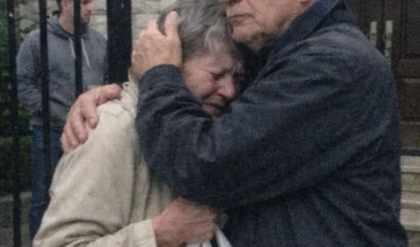
Ronan sank to his knees without quite realizing he was doing it, the motion driven less by choice than by the weight of recognition settling into place all at once.
“I thought everyone forgot,” he said, his voice rough, unsteady in a way it hadn’t been before.
Dorothy stepped closer, her hand resting lightly on his shoulder.
“Not everyone,” she replied.
For a long moment, neither of them spoke, the world moving around them as if nothing extraordinary had happened, even though everything had changed in the space of a few sentences.
When Ronan finally stood again, something about him had shifted, not in appearance, not in posture, but in the quiet space behind his eyes, where a piece of the past had just found its way back.
He finished changing the tire without another word, his movements slower now, more thoughtful, as if he were carrying something new inside him that required care.
Dorothy watched him, no longer with fear, but with a kind of calm that had replaced it entirely.
When he was done, he stepped back, wiping his hands once more.
“You’re good to go,” he said.
She nodded, then reached into her purse, pulling out her wallet.
“How much do I owe you?” she asked.
Ronan shook his head immediately.
“Nothing,” he said. “You already gave me more than enough.”
She studied him for a moment, then closed her wallet.
“Then at least let me buy you lunch,” she said. “There’s a diner up ahead.”
He hesitated, then smiled, a real smile this time, unguarded.
“I’d like that,” he said.
What neither of them knew yet was that the story didn’t end on the side of that highway.
Because when they arrived at the diner, when they sat across from each other with coffee cooling between them and conversation slowly filling in the years that had passed, another piece of the past would surface—one that had nothing to do with memory and everything to do with justice.
A man entered the diner halfway through their meal, his presence unnoticed by most, but not by Ronan.
Ronan’s expression hardened almost instantly.
“You okay?” Dorothy asked.
He didn’t answer right away.
Instead, he watched the man take a seat at the counter, his gaze sharp, focused.
“That’s him,” Ronan said quietly.
“Who?”
“The guy who ran the group home I ended up in after I left Greenville,” he replied, his voice controlled but tight. “The one who made sure kids like me didn’t get a fair shot at anything.”
Dorothy’s expression changed.
“What do you mean?”
Ronan leaned back slightly, his eyes never leaving the man.
“I mean he used to take the support money meant for the kids,” he said. “Cut corners. Ignore problems. Make sure nobody spoke up.”
Dorothy felt something settle into place, a different kind of recognition.
“Are you sure?” she asked.
Ronan nodded once.
“I never forgot his face.”
Dorothy reached into her purse again, this time pulling out her phone.
“Then maybe it’s time someone else sees it too,” she said.
What followed happened quietly, without confrontation, without raised voices, but with a kind of steady determination that had nothing to do with anger and everything to do with making something right.
Dorothy made a call.
Then another.
Names were mentioned.
Details shared.
By the time they left the diner, the man at the counter had already been approached, not by them, but by authorities who had been waiting for someone willing to speak clearly enough to connect the pieces that had been scattered for too long.
Ronan watched from a distance, his expression unreadable until the man was led out, his confidence gone, replaced by something far less certain.
“Guess some things don’t stay buried forever,” Ronan said.
Dorothy nodded.
“Not when the right people remember,” she replied.
As they stood together in the parking lot, the heat no longer felt as oppressive, the world no longer as uncertain, both of them understood something that had taken years to come full circle.
A moment that began with fear had led to recognition.
Recognition had led to truth.
And truth, when it finally found its way into the open, had a way of setting things exactly where they belonged.
Dorothy got back into her car, this time without locking the doors immediately.
Ronan climbed onto his motorcycle, the engine coming to life beneath him.
“Take care, Mrs. Givens,” he said.
“You too, Michael,” she replied.
He smiled at the name, then nodded once before pulling onto the highway, the sound of the engine fading into the distance—not as something to fear, but as something remembered, understood, and, finally, at peace.
And for the first time in a long while, Dorothy realized that sometimes being wrong about someone isn’t a mistake at all.
Sometimes, it’s the beginning of getting everything right.